Claude Certified Developer: what it's worth for a student
Career7 min read · 19 October 2026
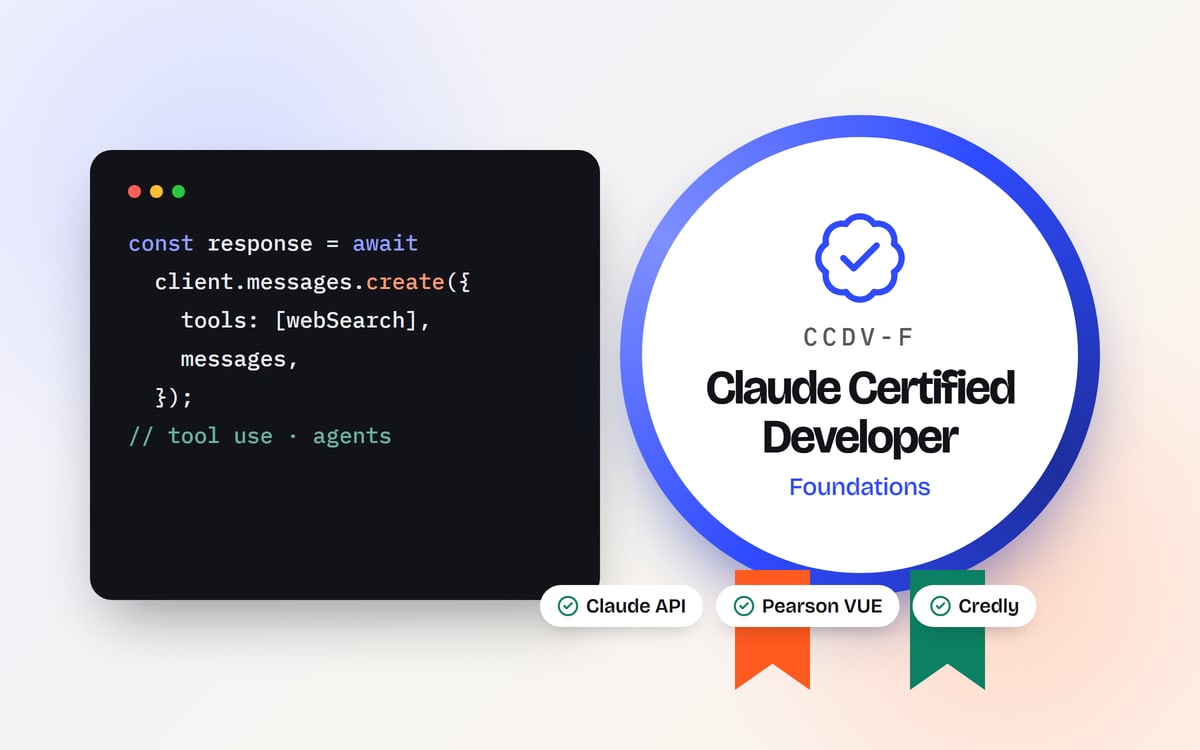
Since July 2026, Anthropic has been certifying developers who build applications with Claude. The exam is called Claude Certified Developer, Foundations. It is proctored by Pearson VUE and comes with a verifiable badge. On paper, it’s the CV line that people who code with AI were missing. In practice, there’s an access condition that few guides spell out. Here’s what the certification validates, what it really signals, and how to prepare while you’re still a student.
In short: the Developer certification is one of four exams Anthropic announced on 23 July 2026. It validates skills in the Claude API, tool use and agent development. The exam is proctored, with an identity check, and earns a Credly digital badge. But it is reserved for members of the Claude Partner Network, a network of organisations, not individuals. For a student, the most realistic route goes through a partner company, as an intern or apprentice. Meanwhile, free courses and a real project on the API build the same skills.
Where this certification comes from
It starts on 12 March 2026. Anthropic launches the Claude Partner Network, a programme for organisations that help companies adopt Claude, with 100 million dollars committed for 2026 for training, technical support and joint market development. The network comes with a first exam, Claude Certified Architect, Foundations, for solution architects. Anthropic also announces more certifications “for sellers, architects, and developers” later in the year.
The next step comes on 23 July 2026, in an article published on claude.com: the programme grows to four certifications, organised by role.

The exam codes (CCAO-F, CCDV-F, CCAR-F, CCAR-P) appear on the official Pearson VUE page, which runs the exams.
What the Developer certification validates
According to Anthropic, the Developer, Foundations certification is for “engineers building applications with Claude”. It covers three areas:
- The Claude API: calling the model from your code, handling messages, parameters and responses.
- Tool use: letting the model call functions you define, such as a search, a database or a calculation.
- Agent development: programs that chain several steps and tools to reach a goal.
Anthropic does not publish the detailed domain breakdown or weightings on its public pages. Pearson VUE flags one thing that matters if you want to start now: exam content changes on 7 December 2026, and updated prep guides will be available from 17 November 2026.
Why it’s a real signal, not just another certificate
The exam is proctored. That’s the difference with most online certificates, which only prove you watched videos. Here, you sit the exam under supervision, online through OnVUE or at a Pearson test centre, with an identity check. Pearson even describes the programme as “the first proctored certification among AI labs”. That’s the view of Pearson, a partner in the programme, not an independent ranking, but the proctoring itself is a verifiable fact.
The badge can be checked in one click. If you pass, you get a Credly digital badge. A recruiter can click it and confirm it’s genuine, without taking your word for it.
It matters to the companies that hire. This is probably the most concrete argument. In the Claude Partner Network, the number of certified people determines a company’s standing. According to Anthropic, the top tier, Global Premier, requires 1,000 certified practitioners. Partner consultancies and IT services firms therefore have a very direct reason to train and hire certified profiles. As early as October 2025, Deloitte announced a programme to train and certify 15,000 of its professionals on Claude.
It names skills that are in demand. The API, tools and agents are exactly what separates someone who “uses ChatGPT” from someone who can build a product with a model. The certification puts an official name on that difference.
The condition few guides spell out
Anthropic states it plainly: the exams “are available to members of the Claude Partner Network”. Membership is free, but it is for organisations that bring Claude to their clients. Those companies register their staff. Pearson VUE confirms that registration starts on the Anthropic Partner Academy, the training platform reserved for partners.

In practice, under these rules, a student on their own, without a partner company, cannot register. Anthropic does not say explicitly whether an individual can sit the exam without a partner organisation. If you read otherwise on a forum, check on the Partner Academy before counting on it.
Price and format aren’t on Anthropic’s or Pearson’s public pages either. Unofficial prep guides, such as Udemy’s, mention a fee of around 125 dollars and a 12-month validity. Treat those figures as a hint, not as confirmed information. Pearson does publish the retake rules: a 14-day wait after a first failed attempt, 30 days after the second, 90 days after the third, and no more than 4 attempts in any rolling 12-month period.
How to prepare as a student
Aim for a partner company for your internship or apprenticeship. That’s the most direct route. Anthropic runs a Services Partner Directory that client companies browse. In an interview, asking whether the company is in the network and certifies its teams shows you know the subject. And since certifications weigh on a partner’s standing, the company has a reason to pay for yours.
Start with the free courses. Claude Academy offers free courses, open to everyone, on the fundamentals: working with AI, understanding what a model can and can’t do, teaming up with agents. They’re not the exam prep courses, which are reserved for partners, but they lay the groundwork.
Build a real project. It’s the best preparation for the exam’s three areas, and it’s already worth something on a CV, certification or not. A small tool that calls the API, uses two or three functions you wrote, and chains a few steps on its own. Put it on GitHub with a README that explains your choices.
Learn the open building blocks. The Model Context Protocol, used to connect a model to tools and data, is an open protocol: what you learn about it will also help you with models other than Claude.
Our take
The Developer certification has two rare qualities: a proctored exam and a verifiable badge, focused on concrete skills. It also has two limits. It covers a single vendor’s ecosystem, and it’s young: launched in 2026, it already changes in December. Above all, it’s designed for employees of partner companies, not for students.
So the right strategy for you isn’t to chase the badge. It’s to build the skills it validates, show them through a project, and aim for a company that will let you take it. The day you get access, you’ll be ready. Until then, your project will speak for you.
FAQ
Can a student take the Claude Developer certification on their own?
According to Anthropic, the exams are reserved for members of the Claude Partner Network, a network of organisations that register their staff. Anthropic doesn’t say explicitly that an individual can register without an organisation. The safest route is a partner company, through an internship or apprenticeship.
How much does the Claude Developer certification cost?
Anthropic and Pearson VUE don’t publish the price on their public pages. Unofficial guides mention around 125 dollars. In a partner company, the exam is often covered, since the number of certified staff counts towards the company’s standing in the network.
What do you need to know to pass?
Anthropic lists three areas: the Claude API, tool use and agent development. Content changes on 7 December 2026, and new guides arrive on 17 November 2026. The best training is still a real project that combines all three.
Do Anthropic’s free courses give you the certification?
No. Claude Academy offers free courses open to everyone, but that isn’t the proctored exam. The certification-specific prep courses are on the Partner Academy, reserved for network members.
Does the certification replace a degree or a portfolio?
No. It proves specific skills on one ecosystem, and it has to be renewed. A visible project on GitHub, with an explanation of your choices, is at least as strong an argument, and it doesn’t depend on any access condition.
Further reading
Sources
- Four role-based certifications for the people who put Claude to work for customers — Claude (Anthropic) · accessed 19 October 2026
- Claude Certification Program by Anthropic — Pearson VUE · accessed 19 October 2026
- Anthropic invests $100 million into the Claude Partner Network — Anthropic · accessed 19 October 2026
- Deloitte and Anthropic partnership — Anthropic · accessed 19 October 2026
- Claude Academy: free courses — Anthropic · accessed 19 October 2026
- Claude Certifications in 2026: Which One Is Right for You? — Udemy (unofficial guide) · accessed 19 October 2026