Why Yann LeCun wants AMI: AI beyond LLMs
AI news9 min read · 27 September 2026
In November 2025, Yann LeCun announced he was leaving Meta after twelve years. Four months later, his Paris-based start-up AMI Labs announced it had raised $1.03 billion to build AI that doesn’t rely on large language models. Why is one of the founding figures of deep learning betting against the technology behind ChatGPT, Claude, and Gemini? And why should you care, even if you never plan to become a researcher?
In short: Yann LeCun, winner of the 2018 Turing Award, believes LLMs, which are trained to predict text, won’t lead to human-level intelligence: they lack an understanding of the physical world, persistent memory, reasoning, and planning. His company AMI Labs (Advanced Machine Intelligence), run by CEO Alexandre LeBrun, wants to build “world models” based on the JEPA architecture, which learns mostly from video. It raised $1.03 billion (about €890 million), at a $3.5 billion pre-money valuation according to TechCrunch. It’s a long-term bet with no product for years, and many researchers think LLMs are still improving fast. For students, it opens concrete paths: computer vision, robotics, self-supervised learning.
 Photo: École polytechnique, CC BY-SA 2.0, via Wikimedia Commons.
Who is Yann LeCun?
A French computer scientist, Yann LeCun received the 2018 Turing Award in 2019, alongside Geoffrey Hinton and Yoshua Bengio, “for conceptual and engineering breakthroughs that have made deep neural networks a critical component of computing” (ACM). His best-known contribution is convolutional neural networks, developed in the 1980s and first trained on handwritten digits at the University of Toronto and Bell Labs. They became an industry standard in computer vision.
A professor at NYU, a position he’s keeping (TechCrunch), he spent twelve years at Meta: five as founding director of the FAIR lab and seven as Chief AI Scientist, as he put it in his own farewell message (Euronews).
Leaving Meta
In November 2025, LeCun confirmed he would leave Meta at the end of the year to start a company dedicated to what he calls Advanced Machine Intelligence. The stated goal: systems that understand the physical world, have persistent memory, can reason, and can plan complex action sequences. Meta stays on as a “partner” of the new company (Euronews).
Context matters. According to Fortune, Meta had pivoted toward ever more powerful language models under its new chief AI officer, Alexandr Wang. That ran against LeCun’s conviction, which he sums up simply: we won’t reach human-level AI just by scaling up LLMs.
AMI Labs: what we know
 Logo: AMI Labs, trademark of its owner.
AMI Labs officially launched on March 10, 2026 (AMI Labs). The key facts:
- Headquarters in Paris, with teams in New York, Montreal, and Singapore from day one.
- Funding of $1.03 billion (about €890 million), co-led by Cathay Innovation, Greycroft, Hiro Capital, HV Capital, and Bezos Expeditions, with backers including Nvidia, Samsung, Temasek, and Toyota Ventures, plus individuals such as Eric Schmidt and Tim Berners-Lee. Valuation: $3.5 billion pre-money, according to TechCrunch.
- Team: LeCun is executive chairman, not CEO. Around him are Laurent Solly (Meta’s former VP for Europe) as COO, Saining Xie as chief science officer, Pascale Fung as chief research and innovation officer, and Michael Rabbat as VP of world models.
- Recognition: in June 2026, AMI Labs joined the Next40, France’s list of its most prominent start-ups (AFP).
- Hiring: in late September 2026, its careers page lists seven openings in Paris and Singapore, including a role open to interns in geometry and 3D vision.
Alexandre LeBrun, the CEO
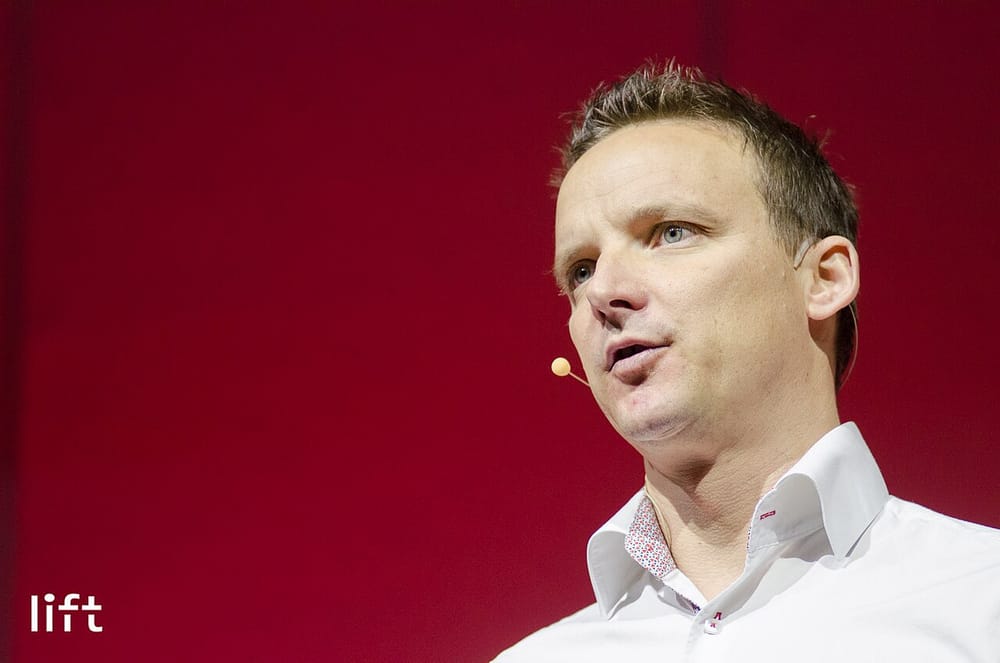 Photo: liftconferencephotos (Lift Conference), CC BY 2.0, via Wikimedia Commons.
Alexandre LeBrun is a serial entrepreneur. After selling VirtuOz to Nuance, he co-founded Wit.ai, an API that lets developers add natural language understanding to their apps; Facebook acquired it in January 2015, when 6,000 developers were using it (TechCrunch). He then worked at Meta, where he led FAIR’s engineering in Paris (MIT Technology Review), before co-founding Nabla, a health AI start-up he now chairs. Nabla is also AMI Labs’ first announced partner. His tongue-in-cheek prediction: “My prediction is that ‘world models’ will be the next buzzword. In six months, every company will call itself a world model to raise funding” (TechCrunch).
The thesis: why LLMs aren’t enough, in his view
An LLM learns by predicting the next word in a text. For LeCun, that’s precisely the limit: “LLMs are limited to the discrete world of text,” he told MIT Technology Review. He describes the belief that scaling these models up will eventually reach human-level intelligence as an “illusion, or delusion” that is “simply false.”
The AMI Labs website sums up what the team thinks is missing in four points. AI systems should:
- understand the real world;
- have persistent memory;
- be able to reason and plan;
- be controllable and safe.
Their motto: real intelligence does not start in language, it starts in the world. Think of a child who learns that objects fall by watching them fall, long before learning to read. Text describes the world, but it doesn’t contain everything that sight and touch teach. LeCun has made the point for years in his own way: today’s models don’t even have what a house cat has, namely memory, reasoning, planning, and an understanding of the physical world (TechCrunch).
World models, JEPA, V-JEPA: the alternative, explained
A world model works like an internal simulator: it lets an AI predict the outcome of an action before taking it, and therefore plan (Meta AI).
The tool LeCun champions is called JEPA (Joint Embedding Predictive Architecture). The core idea: instead of reconstructing every missing pixel of an image or video, the model predicts an abstract representation of what’s missing. That lets it ignore unpredictable details (the exact movement of every leaf on a tree) and focus on what matters. The milestones, all published by Meta while LeCun was there:
- I-JEPA (June 2023), for images, with training code and model checkpoints released as open source (Meta AI).
- V-JEPA (February 2024), for video. According to Meta, the approach improves training and sample efficiency by a factor of 1.5 to 6 (Meta AI).
- V-JEPA 2 (June 2025): 1.2 billion parameters, pre-trained on over a million hours of video, then on 62 hours of robot data. Meta reports 65 to 80% success on picking and placing unfamiliar objects in unseen environments: figures self-reported by Meta. Code and model checkpoints are open (Meta AI).
- LeJEPA (November 2025), a paper by Randall Balestriero and Yann LeCun that gives JEPA a theoretical foundation and removes several ad-hoc training tricks (arXiv).
| LLM | JEPA-style world model | |
|---|---|---|
| What it predicts | The next word | An abstract representation of what happens next |
| Main data | Text | Video, images, sensors |
| Strength | Language, code, knowledge | Physics, action planning |
| Maturity | Products used by millions | Research, early robotics results |
Open research as a conviction
AMI Labs commits to working with the academic community “via open publications and open source” (AMI Labs), and its founders say they’ll release a lot of code (TechCrunch). LeCun criticises the closed approaches of OpenAI and Anthropic and argues for a wide diversity of AI assistants, for the same reason a society needs a diverse press (MIT Technology Review).
Why Paris?
LeCun gives three reasons in MIT Technology Review. Talent: Europe has a very high concentration of researchers but doesn’t always give them the right environment to flourish. Sovereignty: many countries want some control over AI. And demand from industry and governments for “a credible frontier AI company that is neither Chinese nor American.” Add a simple fact: LeBrun was already running FAIR’s engineering in Paris. For more on the French ecosystem, see France in the AI race.
The criticism
LeCun’s bet is far from universally accepted.
- LLMs may already understand. Geoffrey Hinton, who shared the Turing Award with him, answers “Yes” when asked whether these systems can understand, and “Yes” again when asked whether they’re intelligent (CBS News).
- LLMs keep improving. In July 2025, a version of Gemini achieved a gold-medal score at the International Mathematical Olympiad, certified by the coordinators (Google DeepMind). Demis Hassabis sees the road to AGI as a combination of foundation models and reinforcement learning for planning (Business Today).
- The idea isn’t new. Gary Marcus accuses LeCun of not crediting predecessors: Jürgen Schmidhuber argued for world models as early as 1990, as did Marcus himself with Ernest Davis in 2019 (Gary Marcus’s Substack).
- Time and money. AMI has no product, and LeBrun admits it could take years to go from theory to commercial applications (TechCrunch).
- Competition. Google DeepMind also presents Genie 3, released in August 2025, as a world model and a stepping stone toward AGI (Google DeepMind). AMI isn’t alone in this space.
What to watch
- The first models. LeCun said he wants to release them “quickly,” according to SiliconANGLE. Watch whether they arrive, and whether they’re truly open.
- Measurable results. Meta released physical-reasoning tests alongside V-JEPA 2 (IntPhys 2, MVPBench, CausalVQA). AMI’s progress on tests like these will show whether the thesis holds.
- Industrial partners. AMI targets industrial process control, automation, wearables, robotics, and healthcare. Nabla is the first partner: what comes of it will show whether theory turns into product.
- Hiring, especially in Paris, which shows where the money is going.
What it means for you as a student
AMI’s own job postings are the best roadmap (AMI Jobs). The minimum: a degree in computer science or equivalent, strong Python, machine learning fundamentals and experience with GPU training, and the ability to run an experiment end to end. They value self-supervised learning, video and multimodal architectures, planning algorithms, model evaluation, and open-source work. The 3D vision role adds 3D reconstruction, SLAM, depth and pose estimation, and hands-on use of a rendering or simulation engine such as Blender or Isaac Sim.
In practice:
- Fields of study: world models sit at the crossroads of computer science, computer vision, robotics and control engineering, applied maths, physics, and even cognitive science.
- Read the source papers. Start with Meta’s posts on I-JEPA and V-JEPA 2, then the LeJEPA paper. Use AI as a coach that helps you understand, not as a summary you copy.
- Reproduce something. V-JEPA 2’s code is public: getting a model to run and presenting its limits is worth more than “passionate about AI” on a CV.
- Don’t bet everything on one paradigm. Python, probability, optimisation, and experimental method are useful whether LeCun turns out to be right or not.
FAQ
What is a world model in AI?
It’s a model that learns how the world evolves, often from video, so it can predict the consequences of an action before taking it. It acts as an internal simulator for a robot or an agent that needs to plan.
Is Yann LeCun against ChatGPT and LLMs?
He doesn’t say they’re useless, only that they won’t reach human-level intelligence on their own. Alexandre LeBrun presents world models as a complementary way to solve problems that LLMs can’t (Maddyness).
How much has AMI Labs raised?
$1.03 billion, or about €890 million, announced on March 10, 2026. TechCrunch reports a pre-money valuation of $3.5 billion.
Does AMI Labs hire interns?
In late September 2026, its careers page lists a research role open to interns in geometry and 3D vision, based in Paris. Openings change quickly, so check the page directly.
What should I study to work on world models?
A solid degree in computer science or applied maths, with computer vision, machine learning, and ideally robotics. Practice matters just as much: projects, paper reproductions, open-source contributions.
Further reading
- The AI race: why some people are scared and others aren’t: where LeCun sits among the worried, the skeptics, and the optimists.
- France in the AI race: the ecosystem AMI Labs is part of.
- The resume-article-scientifique skill: a coach to help you read a paper like V-JEPA 2 without getting lost.
- The articles-scientifiques connector: find publications on JEPA and world models, with ready-made citations.
Sources
- Official launch — AMI Labs · accessed 27 September 2026
- AMI Labs (official website) · accessed 27 September 2026
- Yann LeCun's AMI Labs raises $1.03B to build world models — TechCrunch · accessed 27 September 2026
- Who's behind AMI Labs, Yann LeCun's world model startup — TechCrunch · accessed 27 September 2026
- Yann LeCun's new venture is a contrarian bet against large language models — MIT Technology Review · accessed 27 September 2026
- Yann LeCun's AMI Labs startup, valuation and Meta departure — Fortune · accessed 27 September 2026
- French godfather of AI Yann LeCun confirms he is leaving Meta to launch AI start-up — Euronews · accessed 27 September 2026
- Yann LeCun lance AMI Labs et lève plus d'1 milliard de dollars — Maddyness · accessed 27 September 2026
- IA : la start-up de Yann LeCun intègre le palmarès des entreprises de la French Tech — AFP (via TradingView) · accessed 27 September 2026
- Fathers of the Deep Learning Revolution Receive ACM A.M. Turing Award — ACM (GlobeNewswire) · accessed 27 September 2026
- Facebook acquires Wit.ai — TechCrunch · accessed 27 September 2026
- I-JEPA: The first AI model based on Yann LeCun's vision for more human-like AI — Meta AI · accessed 27 September 2026
- V-JEPA: The next step toward advanced machine intelligence — Meta AI · accessed 27 September 2026
- V-JEPA 2 world model and new benchmarks for physical reasoning — Meta AI · accessed 27 September 2026
- LeJEPA: Provable and Scalable Self-Supervised Learning Without the Heuristics — arXiv · accessed 27 September 2026
- Meta's Yann LeCun says worries about AI's existential threat are 'complete B.S.' — TechCrunch · accessed 27 September 2026
- Geoffrey Hinton on the promise, risks of artificial intelligence (transcript) — CBS News, 60 Minutes · accessed 27 September 2026
- Advanced version of Gemini with Deep Think officially achieves gold-medal standard at the IMO — Google DeepMind · accessed 27 September 2026
- India AI Impact Summit 2026: Demis Hassabis predicts artificial general intelligence within 8 yrs — Business Today · accessed 27 September 2026
- The False Glorification of Yann LeCun — Gary Marcus (Substack) · accessed 27 September 2026
- Genie 3: A new frontier for world models — Google DeepMind · accessed 27 September 2026
- Yann LeCun's new startup AMI Labs raises $1.03B to train world models — SiliconANGLE · accessed 27 September 2026
- AMI Jobs — AMI Labs job board (Ashby) · accessed 27 September 2026
- Yann LeCun - 2025 (cropped).jpg — Wikimedia Commons · accessed 27 September 2026
- Alex Lebrun (25023487455).jpg — Wikimedia Commons · accessed 27 September 2026



.jpg)
.jpg)